
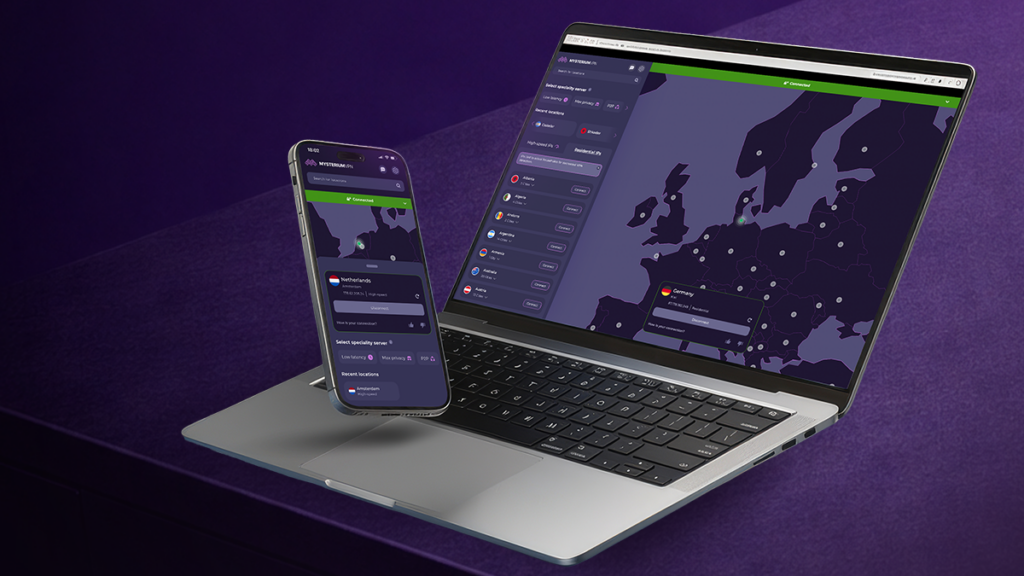
A VPN is usually sold as a simple idea. Open an app, press a button and suddenly the internet thinks you're somewhere else. Easy enough.
But there’s a question that tends to get lost somewhere between the giant “Connect” button and the endless privacy claims: who actually controls the network carrying that connection?
That question becomes much more interesting when looking at a decentralized VPN.
Instead of routing everyone through servers owned or controlled by one central company, a decentralized VPN can use a network of independent nodes operated by people in different parts of the world. It’s a very different model, and in 2026, when online censorship, regional restrictions and concerns about centralized internet infrastructure continue to make headlines, the idea feels less like a tech experiment and more like something worth paying attention to.
So, how does the connection actually work?
The easiest way to understand a decentralized VPN is to forget the complicated terminology for a moment.
With a traditional VPN, a company generally owns or manages the servers that users connect through. The company decides where those servers are, maintains the infrastructure and controls the network.
A decentralized VPN takes a different route.
The network can be made up of independent nodes, sometimes operated by people or organizations around the world. Instead of one company controlling every exit point, the network distributes that role among multiple participants.
Anyone wondering how does decentralized vpn work will probably find the concept surprisingly straightforward once the jargon is stripped away. A user's traffic is encrypted and routed through a selected node, while the decentralized structure means there isn't one central infrastructure provider controlling every connection.
Think of it like taking a road trip. A traditional VPN is a bit like having one giant taxi company with all the cars parked in its own garages. A decentralized network is closer to having thousands of independent drivers spread across different cities.
Same destination. Very different setup.
Why independent nodes matter
The biggest appeal isn't just that the network sounds more futuristic.
It’s about control.
When a VPN relies entirely on centralized infrastructure, the provider has a significant role in deciding how that infrastructure operates. That doesn't automatically make a traditional VPN bad, but it does create a single organizational center.
Peer-based networks try to reduce that dependence.
Peer vpn nodes can be operated by independent participants around the world rather than being owned entirely by one central company. For users, that can mean access to a much broader and more varied network.
There’s also an obvious geographic advantage.
A network with independent participants spread across many countries can offer users more options when choosing where their connection appears to originate. In this case, the network covers more than 100 countries and includes over 7,500 residential IPs.
That last part is particularly interesting because residential addresses can look more like ordinary household internet connections than the typical IP addresses associated with large data centers.
This isn't only about privacy
Privacy is obviously part of the story, but it isn't the whole story.
The philosophy behind this type of network is closely connected to internet freedom. In many parts of the world, access to websites, news, social platforms and online services can depend on where someone happens to live.
That can feel strange when the internet is supposed to connect everyone.
A decentralized VPN is designed to make those geographical barriers less significant. It can help users change their apparent location and access the internet through different parts of the network.
That doesn't mean every restriction suddenly disappears. Websites and platforms can still block specific addresses, and governments can impose restrictions that a VPN can't simply wish away.
Still, having more connection choices gives users more room to maneuver.
And in 2026, that matters.
What makes the residential side interesting?
Residential IPs are one of the more unusual parts of this setup.
A regular VPN connection may come from an IP address associated with a commercial data center. That's perfectly normal, but some websites have become very good at identifying large groups of addresses commonly used by VPNs.
Residential IPs come from residential internet connections instead.
That can make them useful for people who regularly encounter location restrictions, aggressive anti-VPN systems or websites that simply don't behave well when they detect a conventional VPN connection.
The network offers thousands of residential IPs across more than 100 countries, along with location selection.
It isn't a guarantee that every website will accept every connection. Internet platforms change their detection systems all the time. But having a larger pool of residential addresses can give users more flexibility than a small collection of conventional VPN servers.
A different philosophy behind the service
The broader idea here is bigger than simply hiding an IP address.
The project positions itself around three themes: freedom from surveillance, resilience against censorship and support for a more decentralized internet.
That's quite a strong statement compared with the usual VPN advertising about watching foreign TV shows in your pajamas.
And it reflects a wider conversation happening online in 2026. More services are becoming centralized, platforms are increasingly powerful gatekeepers and access to information can vary dramatically depending on geography.
A dvpn doesn't magically solve those problems. But the underlying philosophy is easy to understand: don't put all the infrastructure, control and trust in one place if it doesn't have to be that way.
Where this approach makes the most sense
A decentralized VPN won't necessarily be the perfect choice for everyone.
Someone who only wants to connect to the nearest VPN server once in a while may never care whether the infrastructure is centralized or decentralized.
For people dealing with censorship, location restrictions, residential IP requirements or websites that frequently dislike conventional VPN connections, however, the difference becomes much more relevant.
The combination of independent nodes, residential IPs and broad geographic coverage gives the model a practical reason to exist beyond simply being different for the sake of being different.
That's probably the most important point.
The bigger picture
The internet has changed dramatically over the last decade. Privacy tools used to feel like something only particularly cautious people cared about. Today, the average internet user has to think about tracking, data collection, regional restrictions, account security and increasingly sophisticated attempts to control online access.
A decentralized VPN offers another way of approaching those problems.
Rather than putting all the trust in one centralized network, it distributes the infrastructure across independent participants. That can create more choice, more geographic flexibility and a different relationship between the user and the network itself.
Is it perfect? No.
Is it interesting? Absolutely.
For anyone who has become tired of the same old VPN model and wants to understand what comes next, decentralized networks are worth watching. And with thousands of residential IPs and nodes spread across more than 100 countries, this isn't just a theoretical idea sitting in a developer's notebook anymore.
The real question is whether more internet users will start asking the same thing: who controls the road their data travels on?