
Choosing a proxy provider sounds simple until you actually start comparing the options. Then suddenly you're looking at IP types, locations, rotation settings, connection limits and about twelve different tabs wondering why you ever started.
I've been looking into the proxy market with one question in mind: what actually matters if the goal is to make online traffic look more like it comes from a normal household connection?
That's where residential proxies caught my attention. Unlike datacenter IPs, residential addresses are generally associated with real internet service providers and household connections. That can make a noticeable difference for websites that are particularly suspicious of automated or unusual traffic.
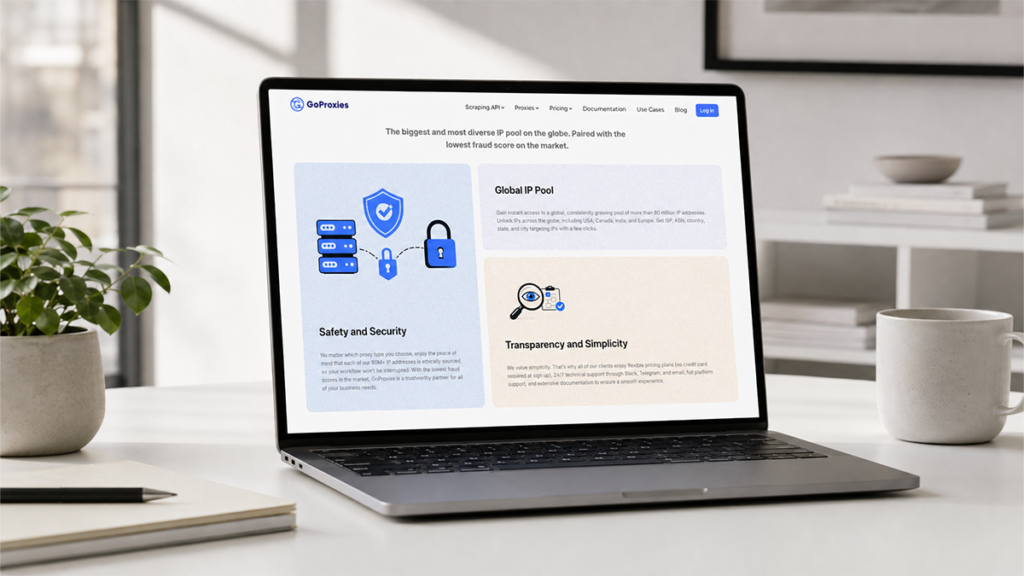
Goproxies is one of the names that came up during my research. So rather than judging it purely from a feature checklist, I looked at it through the lens that matters most to me: how practical is this proxy service for someone who wants residential IPs without turning the whole thing into a networking project?
What Stood Out to Me
The first thing I noticed about Goproxies is that the offering is built around the residential proxy use case rather than trying to be everything to everyone.
That's important because the proxy industry has become pretty crowded. You've got established names such as Bright Data, Oxylabs and Smartproxy, alongside a long list of smaller providers. On paper, they can start looking almost identical.
Residential IPs. Global locations. Rotation. Authentication. Different plans.
Great.
But what happens when you actually need to use them?
For me, the useful distinction is whether the provider makes the basic process feel straightforward. Nobody wants to spend an evening figuring out why an IP works in one browser but not another.
Goproxies positions its residential network around exactly that kind of practical usage, which is why I think it deserves consideration from people who don't necessarily need an enormous enterprise platform.
Why residential IPs matter
This is probably the most important part of the whole discussion.
A proxy essentially sits between your device and the website you're accessing. Instead of the website seeing your normal IP address, it sees the proxy's IP.
But not every proxy IP looks the same.
Datacenter proxies generally come from hosting or cloud infrastructure. They're often fast and can be useful for plenty of legitimate tasks, but websites can sometimes identify those ranges more easily.
Residential proxies are different. They're associated with residential internet connections, which can make the traffic appear more like an ordinary user browsing from home.
Have you ever noticed that some websites seem perfectly happy with your normal browser but suddenly start throwing verification screens at you when you're using a cloud server?
That's the sort of situation where the type and reputation of an IP can matter.
Of course, a residential IP isn't some magical invisibility cloak. Websites can still use cookies, browser characteristics, account behaviour and other signals. That's worth remembering before anyone expects a proxy to solve every problem.
Where Residential Proxies Come in Handy
From the way I approached the comparison, Goproxies makes the most sense for users who specifically want residential IPs and don't necessarily need the huge ecosystem that comes with some of the biggest enterprise-oriented providers.
For example, location-based testing is an obvious use case.
Imagine you're working on a website that serves different content depending on where the visitor is located. Looking at the site from Lithuania, Germany and the United States can produce three different experiences.
Without changing your connection, that's difficult to reproduce accurately.
The same basic idea applies to market research, checking localized search results, verifying advertising or testing how websites behave for users in different regions.
There's also a practical benefit to separating this sort of activity from your everyday connection. Your regular home IP stays your regular home IP rather than becoming part of every experiment you're running.
A Strong Option for Residential Proxy Users
After comparing the main things I’d actually care about in a residential proxy service, Goproxies stands out as the option I’d be most inclined to choose. The combination of residential IP access, location options, flexibility and the overall focus of the service makes it a particularly convincing choice for the kind of everyday proxy work I’m looking at.
What matters to me is that I’m not simply choosing a provider because it advertises the largest IP pool or has the longest feature list. I’d rather have a service that focuses on doing the important things well. With Goproxies, the residential-first approach feels much more aligned with what I’d actually be using the service for.
There’s also something to be said for not paying for a mountain of enterprise features I’ll never touch. Some of the biggest names in the industry have incredibly extensive platforms, which can be useful for large-scale operations, but that doesn't automatically make them the most practical choice for everyone.
For my use case, Goproxies comes across as a more focused option. If residential IPs are the priority, rather than building an enormous enterprise proxy infrastructure, this is the provider I’d put at the top of my comparison.
My takeaway
What I like about approaching Goproxies from the residential-IP angle is that the conversation becomes much simpler.
Instead of asking, "Which proxy provider has the biggest number?"
I'd ask:
"Does it give me the locations, reliability and flexibility I actually need?"
That's a much more useful question.
Goproxies looks particularly relevant for people who want residential connectivity without necessarily needing the complexity of a huge enterprise proxy ecosystem. Meanwhile, providers such as Bright Data, Oxylabs and Smartproxy remain obvious alternatives worth comparing before committing to anything.
And that's probably the biggest lesson from researching proxies: don't buy based on the headline number alone.
A network can advertise millions of IPs, but if the locations you need aren't available or the connections don't behave the way your project requires, that impressive number doesn't help much.
If you're currently comparing residential proxy providers, I'd start by making a short list of the countries you need, how often you need IP rotation and roughly how much traffic you're expecting. Once you know those three things, comparing providers becomes considerably less painful.
If you've used Goproxies or another residential proxy provider recently, I'd be interested to hear how your experience compares. Sometimes the real-world details tell you much more than another feature table ever could.