

A team is so much more than just the players that are on the field. They are all sharing waiting rooms, planes, and the less hectic hours before practice. One thing that they have to fill this time with is some type of focus. A deck of cards supplies that. It creates an opportunity to spend quiet time together competing against each other or talking after the competition.
Traveling with Your Team
In December 2003, there was a report about the Cincinnati Bengals in which quarterback Jon Kitna led a Spades game next to receiver Peter Warrick’s locker. When they boarded the team plane the same activity followed. Cornerback Jeff Burris also participated in the locker room game bringing another unit to the gathering.
This scene illustrates why the practical advantages of playing cards make sense. Playing cards requires very little equipment, and you can take your favorite pastime into many different settings. A locker-room gathering can become a travel routine without the team having to organize a separate activity.
Creating these kinds of routines is important to the overall experience. While the location will change, you already know who likes to compete and which previous result is still being disputed.
A New Type of Partnership
In the four-player partnership version of Spades, partners sit opposite each other. Each player receives a separate hand and makes an individual bid; the two partners’ bids are added to determine their team’s target.
This partnership structure provides a small form of shared accountability. Afterward, you can ask your teammate about their part in determining the final bid without that conversation becoming a criticism of his or her football performance.
While the use of cards doesn’t equate to using the games as a form of training (being good at a card game doesn’t mean that someone is going to be able to read a defense), it allows teammates another environment where they can be competitive with each other. Reserve players may be explaining the rules while well known starters may need help. Just because roles have changed doesn’t mean that the depth chart has changed.
Smartphones Make Possible New Places To Play
Mobile versions of card games move the cards, controls and table onto a smartphone screen, removing the need for a shared physical playing surface.
For example, GipsyTeam’s guide to the Coin Poker app explains how to download the Android client, illustrating the move from a physical deck to a phone. Like with moving from a table to phone this doesn’t necessarily ensure that the social aspect of playing with teammates remains intact. Someone could be playing online and sharing the game with people far away instead of right next to them.
Access to a game is one thing; spending time together is quite another. A phone can provide the first – it cannot provide the second on its own. There isn’t any reason both formats can’t continue as forms of daily leisure.
Teammates Help Create a Novelty
Players have a means of bringing their own individual interests to the group’s common routine through Card Games. At a January 8, 2025, press conference, Washington Commanders Quarterback Jayden Daniels discussed the Samoan card game Suipi, which he remembered being taught during Training Camp.
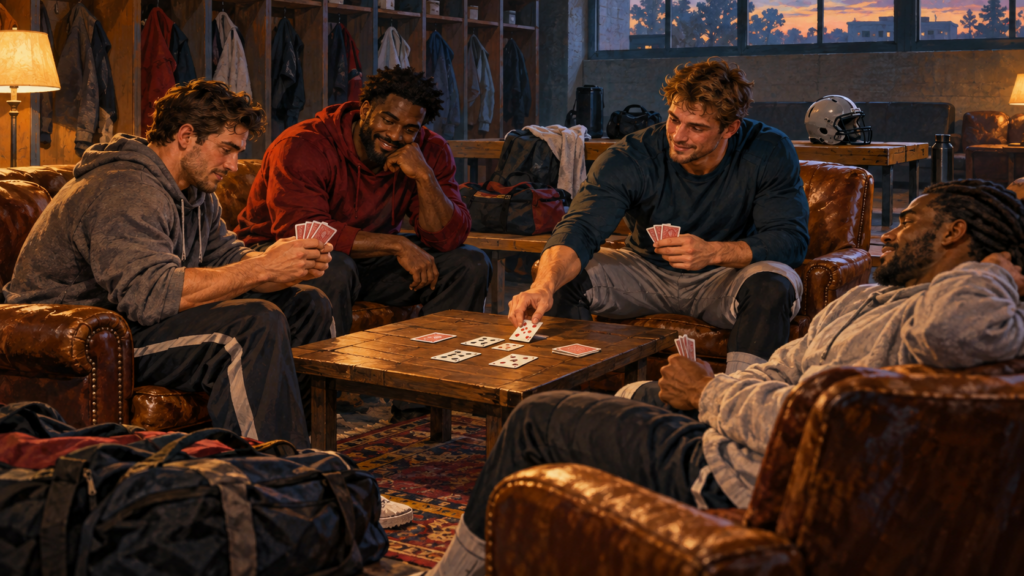
Daniels explained that while the quarterbacks were in the quarterback room, they played other games and spent time together. He described the activity as something they enjoyed doing together.
Different games create a novelty in each of their normal routines. A teammate knowledgeable about the rules of a particular game now has something to share; and someone unfamiliar with the game now has a reason to seek knowledge. This exchange may begin by resolving a specific issue (e.g., what to do when you take your turn), so there is no added pressure of having to find an interesting topic to discuss.
Additionally, this creates a common point of reference for a team outside of their work activities. A memorable hand or a good-natured disagreement about a particular call can become a point of discussion among the team for many days, even though there will likely never be an audience outside of the room.
A Shared Routine Does Not Equal Success
When people talk about cards, stories of team chemistry seem simple. The two examples provided above illustrate people spending time together; however, neither example illustrates how a card game leads to better performance on the football field.
The beneficial outcome is less about winning and more about creating opportunities for teams to interact. One player can engage as a learner; another player can engage as an opponent; yet another player can simply watch the next hand.
How welcoming these interactions feel will depend upon how the group interacts with its members. A member who can ask a novice type of question without feeling embarrassed is going to have a much different experience than a member expected to learn all of the rules immediately. There needs to be space within the team for members that prefer different types of pastimes.
Card games continue to thrive due to low-cost equipment and flexible occasions. Teams integrate card games into their overall team culture based upon the people who choose to come back and play and those conversations that occur along the way.